
 English
 Español
 русский
News
What Forging Actually Means
Forging is a metal shaping process where solid metal is heated and then compressed with high force — by a hammer, press, or roller — to change its shape while it stays solid. This is the key distinction from casting: forging never melts the metal into a liquid state, it deforms it under pressure while hot (or sometimes cold) and still solid.
That compression does more than shape the part. It also aligns and refines the metal's internal grain structure along the contours of the finished shape, which is the main reason forged parts tend to be stronger and tougher than a cast part of the same alloy and dimensions.
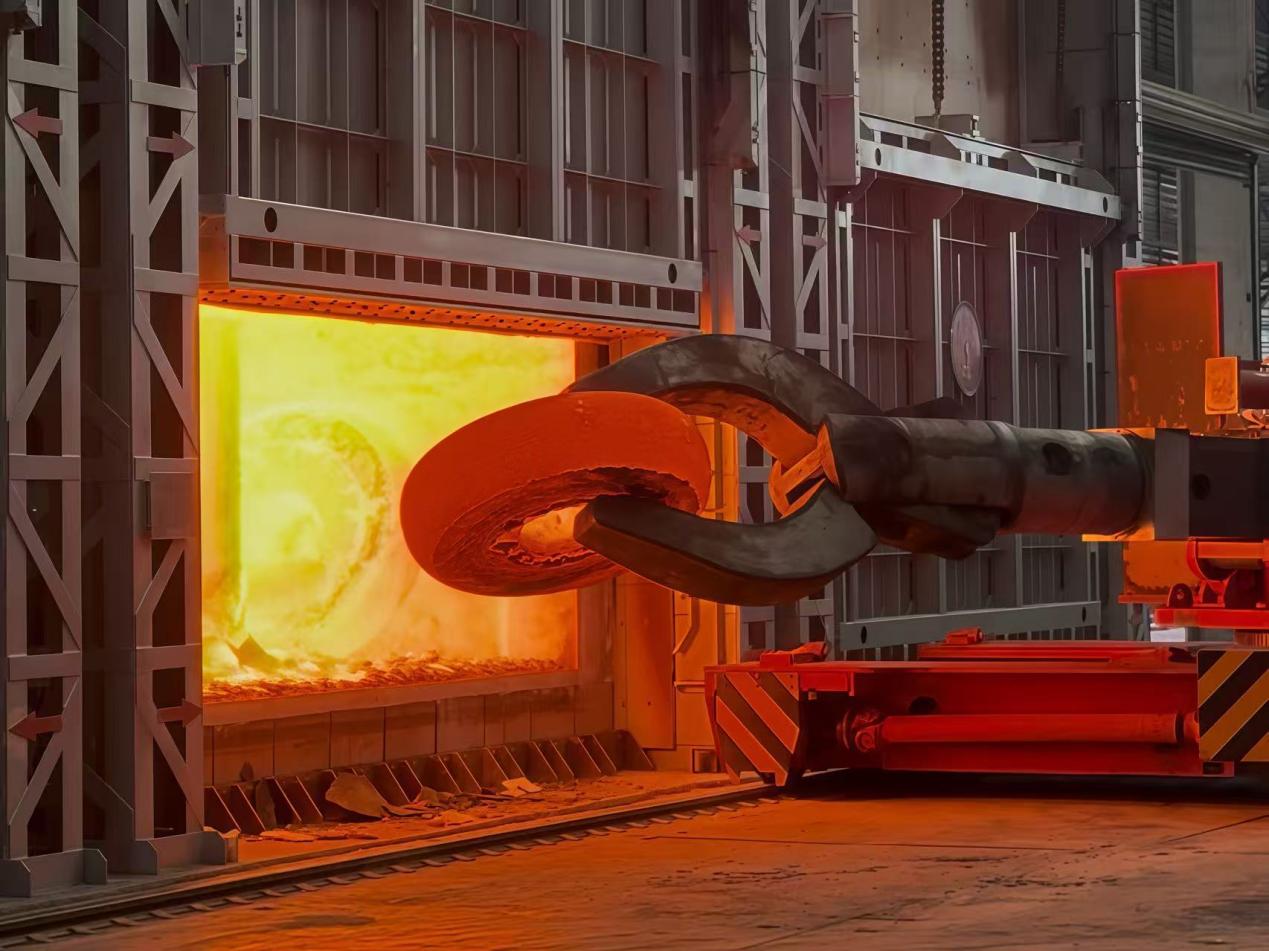
How Steel Is Forged: The Basic Process
- Heating: Steel billet or bar stock is heated to a specific forging temperature, typically well above 1,000°C, to make it plastic enough to deform without cracking.
- Shaping: The heated metal is compressed between dies using a hammer, mechanical press, or hydraulic press, forcing it to fill the die cavity and take on the target shape.
- Trimming: Excess material (flash) that squeezed out along the die parting line is trimmed away.
- Heat treatment: Forged parts are typically normalized, annealed, or quenched and tempered afterward to relieve internal stress and set final mechanical properties.
Forged vs. Cast: Core Property Differences
The underlying difference — deforming solid metal versus solidifying liquid metal — drives most of the practical differences buyers care about.
| Property | Forged | Cast |
|---|---|---|
| Grain structure | Continuous, aligned with part shape | Random, formed during solidification |
| Impact toughness | Higher, resists shock loading better | Lower, more prone to brittle fracture |
| Internal porosity risk | Very low | Higher, depends on casting method and control |
| Shape complexity | More limited without secondary machining | Excellent, complex geometries cast directly |
| Typical cost at low volume | Higher, tooling and process intensive | Lower for simple shapes and small runs |
Cast Iron vs. Steel: How to Tell Them Apart
Cast iron and steel are different alloys, not just different processes, so a few practical checks help distinguish them:
- Spark test: Grinding cast iron produces short, dull red sparks with few branches, while steel produces longer, brighter sparks with more branching.
- Fracture appearance: Cast iron tends to fracture with a dark, granular surface, while steel fractures show a brighter, more fibrous appearance.
- Magnet response: Both are generally magnetic, so this test alone isn't reliable for distinguishing the two.
- Surface texture: Cast parts often show a slightly rough, grainy surface with visible casting marks or parting lines, while forged or machined steel surfaces tend to be smoother.
Forged vs. Cast Golf Clubs
A forged golf club is typically an iron shaped from a single billet of soft carbon steel through repeated pressing and hammering, giving it a denser, more consistent feel that many players describe as softer at impact. A cast club is made by pouring molten steel (often a harder stainless alloy) into a mold, which allows for more complex cavity-back designs and perimeter weighting aimed at forgiveness on off-center hits.
Neither is objectively "better" — forged irons are generally favored by players who value feel and workability, while cast irons are favored for forgiveness and consistency, particularly among higher-handicap players.
Forged vs. Cast Crankshafts
Crankshafts are one of the clearest examples of where forging's grain-structure advantage matters in practice. A forged crankshaft handles the repeated high-stress torsional and bending loads of an engine with greater fatigue resistance than a cast equivalent, which is why forged crankshafts are standard in high-performance, heavy-duty, and racing engines. Cast crankshafts remain common in standard passenger vehicle engines, where loads are lower and the cost savings of casting are significant at high production volumes.
Cast Aluminum vs. Forged Aluminum
The same forged-vs-cast tradeoffs apply to aluminum, with a few aluminum-specific considerations. Forged aluminum parts — common in aerospace fittings, suspension components, and premium wheels — offer a notably better strength-to-weight ratio than cast aluminum, since the grain refinement from forging lets a lighter part carry the same load. Cast aluminum remains the more economical choice for parts with complex internal geometry, such as engine blocks, where forging would be impractical or prohibitively expensive.
Custom Complex Forged Shapes: What's Possible
While forging is traditionally associated with simpler geometries than casting, modern closed-die and precision forging techniques have significantly expanded what's achievable directly from the forging press:
- Multi-step die sequences progressively shape a billet through several stages, allowing complex flange, rib, and boss features to be built up without excessive machining.
- Near-net-shape forging minimizes post-forge machining by getting the forged geometry as close as possible to the final part dimensions.
- Custom die design allows forged parts to incorporate asymmetric features, varying wall thickness, and integrated mounting points tailored to a specific application.
The tradeoff is tooling cost and lead time — custom dies for complex forged shapes represent a significant upfront investment, which is why forging is generally favored for parts justified by strength requirements and production volume rather than shape complexity alone.
 Previous