
 English
 Español
 русский
News
Home / News / Industry News / Steel Forging Explained: Types, Carbon Steel Forgings & Material Selection
Steel forging is a manufacturing process in which a steel workpiece is shaped by applying compressive force — through hammering, pressing, or rolling — while the material is either heated to a plastic state or worked at room temperature. The result is a component with a defined geometry and, critically, a refined internal grain structure that delivers mechanical properties significantly superior to those achievable by casting or machining from bar stock. Forging is not simply a shaping operation; it is a metallurgical process that fundamentally improves the material it works with.
When steel is cast, the solidification process produces a coarse, sometimes dendritic grain structure with potential voids, porosity, and segregation zones. Forging compresses and realigns this structure, closing internal defects, refining grain size, and orienting the grain flow to follow the contours of the finished part. A forged connecting rod, for example, has grain flow that curves through the rod's radius and beam — the same path that tensile and bending loads will travel in service. This alignment is why forged parts resist fatigue failure so effectively in dynamic loading applications.
The forging process is used across virtually every demanding industry: automotive powertrain components, aerospace structural parts, oil and gas valve bodies, construction equipment, hand tools, and military hardware are all routinely produced as forgings. Any application where failure is not an option and mechanical reliability must be guaranteed over a defined service life is a candidate for forged steel.
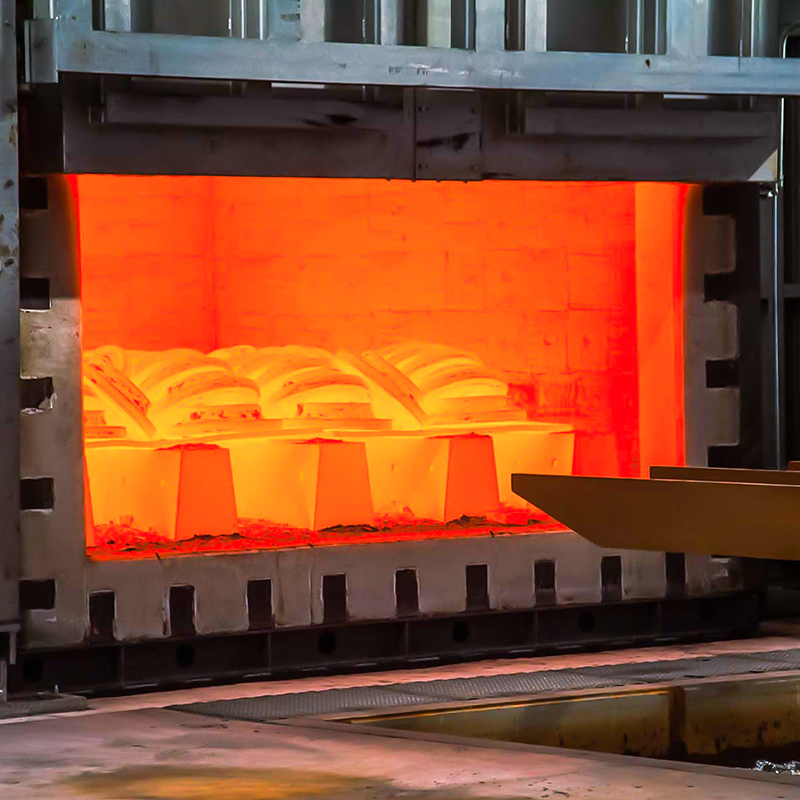
Steel forging is not a single process — it encompasses several distinct methods, each suited to different part geometries, production volumes, tolerance requirements, and material types. Selecting the right forging method is as important as selecting the right steel grade.
In open-die forging, the workpiece is deformed between flat or simply shaped dies that do not fully enclose the material. The operator repositions and rotates the billet between blows to incrementally shape it. Open-die forging is used for large parts — shafts, rings, cylinders, blocks — where closed-die tooling would be prohibitively expensive or where the part is too large for a die set. It is also preferred for custom or low-volume production where tooling investment cannot be amortized over a large run. Dimensional tolerances are broader than closed-die work, and secondary machining is typically required to reach final dimensions.
Closed-die forging uses matched upper and lower dies machined to the near-net shape of the finished part. The heated billet is placed in the die cavity and struck, causing material to flow and fill the impression. Flash — excess material that squeezes out at the die parting line — is later trimmed. This process produces parts with tighter dimensional tolerances, better surface finish, and more consistent mechanical properties than open-die work. It is the dominant forging method for high-volume automotive and industrial components such as crankshafts, connecting rods, gears, flanges, and hand tools.
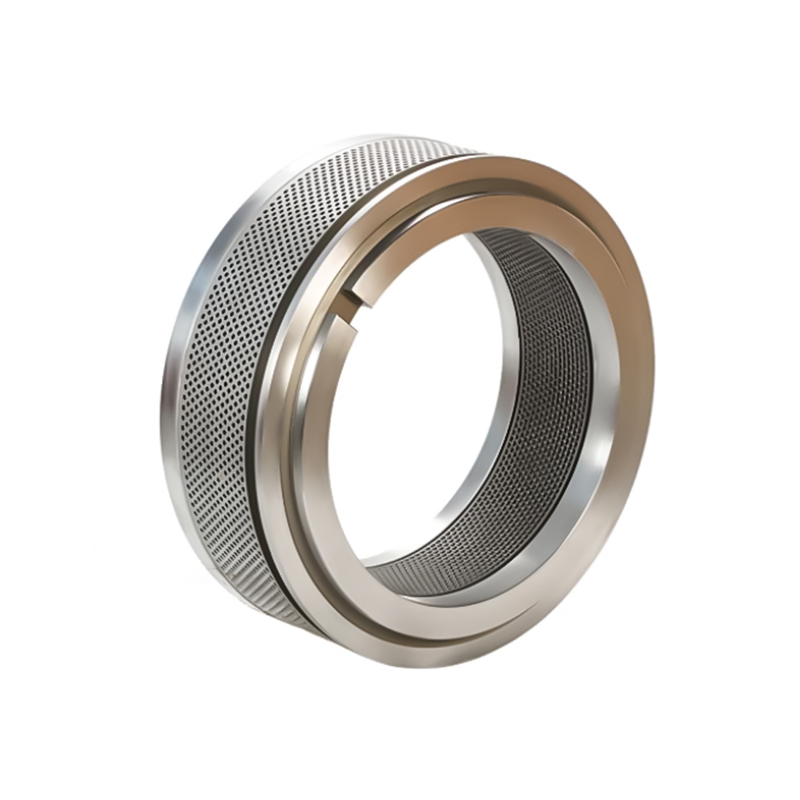
Roll forging passes a heated billet between contoured rolls to reduce cross-section and elongate the piece — used for tapered shafts, leaf springs, and axle blanks. Ring rolling is a specialized variant in which a donut-shaped preform is rolled between an inner mandrel and an outer driven roll, reducing wall thickness and expanding diameter to produce seamless rings. Rolled rings are used extensively in bearings, flanges, pressure vessel components, and aerospace frames. Ring rolling produces uninterrupted circumferential grain flow — a critical advantage in rotating or pressure-containing applications.
Cold forging — performed at or near room temperature — produces parts with excellent surface finish, tight dimensional tolerances, and work-hardened surfaces without a heating step. It is widely used for fasteners, bolts, socket heads, and small precision components. The trade-off is higher forming forces, reduced ductility during processing, and limitations on part complexity compared to hot forging. Most cold-forged parts use low- to medium-carbon steels with good cold-workability.
| Forging Method | Typical Part Size | Dimensional Tolerance | Best For |
|---|---|---|---|
| Open-Die | Medium to very large | Broad (requires machining) | Custom, low-volume, large shafts and blocks |
| Closed-Die | Small to medium | Near-net shape | High-volume automotive and industrial parts |
| Ring Rolling | Rings of all diameters | Good | Bearings, flanges, aerospace rings |
| Cold Forging | Small precision parts | Tight | Fasteners, sockets, high-volume small parts |
Carbon steel is the most widely used raw material in steel forging, prized for its combination of availability, processability, and the wide range of mechanical properties achievable through heat treatment. Carbon steel forgings are specified across construction, agriculture, mining, oil and gas, power generation, and general industrial machinery — anywhere that strength, toughness, and cost-effectiveness are the primary design drivers.
Carbon content is the single most influential variable in forging steel selection:
Heat treatment after forging dramatically alters the final mechanical properties of carbon steel components. Normalizing — air cooling from above the upper critical temperature — refines grain size and relieves forging stresses, producing a uniform microstructure with predictable baseline properties. Quenching and tempering (Q&T) involves rapid cooling from austenitizing temperature to form martensite, followed by reheating to a controlled tempering temperature to restore ductility. Q&T carbon steel forgings can achieve yield strengths exceeding 800 MPa with adequate impact toughness for most structural applications. Annealing is used when maximum machinability or cold formability is required before further processing.
One practical limitation of plain carbon steel forgings is hardenability — the ability to achieve uniform hardness through the cross-section of a large part. Carbon steel has lower hardenability than alloy steel; in thick sections, the core cools too slowly during quenching to fully transform to martensite, resulting in a softer core. For forgings above approximately 75–100 mm in critical cross-section where through-hardening is required, alloy additions such as chromium, molybdenum, or nickel are introduced — transitioning the specification from plain carbon to alloy steel grades such as 4140, 4340, or 8620.
The choice between forged carbon steel, cast steel, and machined bar stock is fundamentally a trade-off between mechanical performance, geometric complexity, production volume, and unit cost. Each process is optimal in a specific context — the engineering error is applying one where another is better suited.
Forged carbon steel versus cast steel: Casting allows far greater geometric complexity — internal passages, undercuts, and hollow sections that forging cannot achieve without secondary operations. But cast steel has inherent microstructural limitations: shrinkage porosity, gas voids, and coarser grain structures that reduce fatigue strength and impact toughness. For parts subject to cyclic or impact loading — crankshafts, hammer heads, lifting hooks, pressure valve bodies — forging's superior grain structure justifies the higher tooling and processing cost. Published data consistently show forged carbon steel components achieving fatigue life 20–30% higher than equivalent cast parts under identical loading conditions, with significantly better Charpy impact values, especially at sub-zero temperatures.
Forged carbon steel versus machined bar: A machined part cut from rolled bar stock has a grain structure oriented along the bar's rolling direction. When machined to a complex shape, the grain flow is interrupted — it runs straight through the part regardless of the geometry. A forged part, by contrast, has grain flow that follows the part contour. For a flanged shaft machined from bar, the grain runs axially through the flange radius — a weak orientation for the bending and shear loads the flange actually experiences. The equivalent forging would have grain flow curving through the flange, aligning with the stress paths. In high-cycle or safety-critical applications, this distinction is not academic: it is the difference between a part that meets its design life and one that does not.
For procurement teams and design engineers, the practical guidance is straightforward: specify forged carbon steel when the part carries dynamic, impact, or fatigue loads; operates in low-temperature environments where ductile-to-brittle transition is a concern; or is a safety-critical component where field failure has serious consequences. Use cast or machined alternatives when geometry demands it, loading is predominantly static, or volume and cost constraints make tooling investment impractical.

No.1317 Gangcheng Road, Daxin Town, Zhangjiagang, Jiangsu, China
WhatsApp:+86-151 5156 6388 Terry Huang
+86-151 5156 6388 Terry Huang
+86-138 1299 2607 Maggie Xia
Terry Huang -VP of Sales
[email protected]
Maggie Xia -VP of Sales
[email protected]

 Previous