
 English
 Español
 русский
News
Home / News / Industry News / Forging vs Casting: The Core Distinction, Mechanical Properties & Application Guide
Forging is a manufacturing process in which solid metal is shaped by applying compressive force — through hammers, presses, or dies — while the metal is either hot (above recrystallization temperature), warm, or cold. The metal is never fully melted. It is deformed in its solid state, which compresses and aligns the internal grain structure of the material.
Casting is a process in which metal is heated to its liquid state, poured or injected into a mold that defines the final shape, and allowed to solidify. When the metal cools, the mold is removed and the part — the casting — retains the geometry of the mold cavity.
The fundamental difference between casting and forging is therefore the state of the metal during shaping: solid and deformed under pressure in forging; liquid and solidified in a mold in casting. This process difference produces materials with distinct internal structures, mechanical properties, and characteristic failure modes — which is why the choice between the two is a design and engineering decision, not simply a cost calculation.
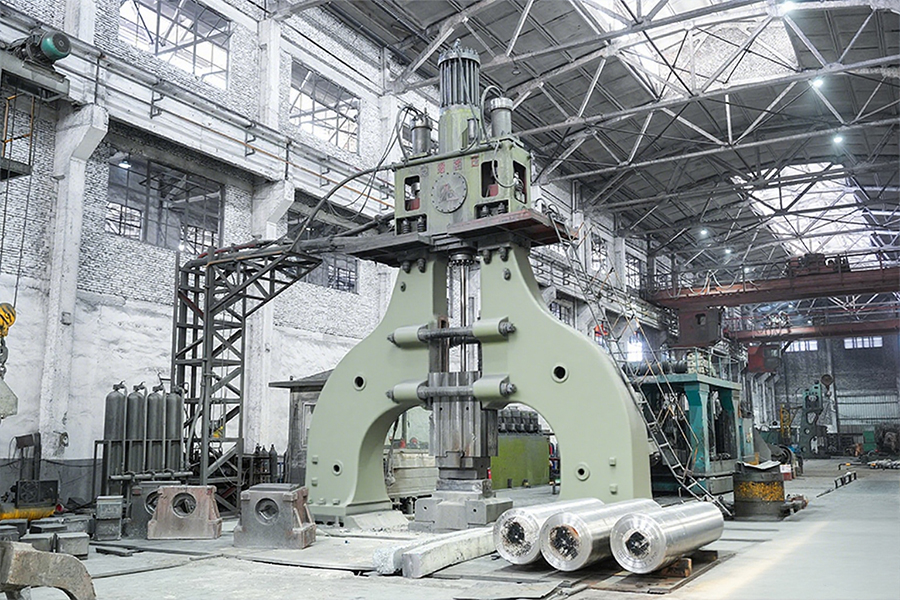
Forging metal involves placing a preheated billet or ingot between dies and applying force until the metal flows into the die cavity. The three principal forging methods are open-die forging, closed-die (impression-die) forging, and seamless ring rolling.
In open-die forging, the metal is worked between flat or simply shaped dies that do not fully enclose the workpiece. The operator repeatedly repositions the billet between hammer blows to achieve the desired shape. Open-die forging is used for large, simple components — shafts, discs, cylinders — and for producing the refined grain structure in billets that will later be machined or closed-die forged.
In closed-die forging, upper and lower dies with machined cavities completely surround the billet. Under press force, metal flows to fill every recess of the die, producing near-net-shape parts with tight dimensional tolerances. This is the process behind most high-volume forged industrial components: connecting rods, crankshafts, flanges, gear blanks, and hand tools.
How is steel forged? Carbon and alloy steels are typically forged at temperatures between 1,100°C and 1,250°C, well above the recrystallization temperature (~450–600°C for most steels), where the metal is plastic enough to flow under die pressure without cracking. The billet is heated in a gas or induction furnace, transferred to the press or hammer, and forged in one or multiple blows or strokes. After forging, parts are heat treated — normalized, quenched, and tempered — to achieve target mechanical properties before finish machining.
What is steel forging in terms of the metallurgical outcome? The compressive deformation refines the grain size, closes internal porosity and voids in the original billet, and elongates the grains in the direction of metal flow — producing a characteristic grain flow pattern that follows the contour of the part. This fibrous grain structure is responsible for the superior fatigue and impact resistance of forgings compared to castings of the same alloy composition.
Cast metal is any metallic component produced by pouring molten metal into a mold. The term encompasses a wide range of alloys — cast iron, cast steel, cast aluminum, cast copper alloys — and a wide range of mold types, from expendable sand molds to permanent metal dies used in die casting and the ceramic shell molds used in investment casting.
What is cast steel? Cast steel is steel that has been melted and poured into molds rather than forged or rolled. It typically contains 0.1–0.5% carbon and may include alloy additions of manganese, chromium, molybdenum, or nickel to achieve target properties. Cast steel has a random equiaxed grain structure — the grains grow from the mold walls inward during solidification with no preferred orientation — which makes it isotropic (equal properties in all directions) but without the directional grain flow strengthening of a forging.
The casting process allows geometries impossible or impractical to forge: internal cavities, complex three-dimensional surfaces, re-entrant features, and very large single-piece structures. Pump housings, engine blocks, turbine casings, and valve bodies are classic casting applications precisely because their internal geometry cannot be produced by die forging at reasonable cost.
The difference between forged and cast steel is most apparent in fatigue life, impact toughness, and tensile ductility. The table below compares typical values for a medium-carbon steel (approximately AISI 1040 equivalent) in cast and forged conditions after equivalent heat treatment.
| Property | Cast Steel (typical) | Forged Steel (typical) |
|---|---|---|
| Tensile strength | 620–720 MPa | 700–900 MPa |
| Yield strength | 380–480 MPa | 490–650 MPa |
| Elongation at break | 15–22% | 20–30% |
| Charpy impact energy | 27–54 J | 81–163 J |
| Fatigue strength (endurance limit) | ~210–240 MPa | ~280–340 MPa |
| Internal porosity | Possible (shrinkage voids) | Absent (closed by forging) |
The impact energy differential is particularly striking: forged steel typically delivers two to three times the Charpy impact toughness of cast steel in the same alloy. This is why safety-critical components subjected to shock loading — crankshafts, connecting rods, axle shafts, suspension knuckles, landing gear components — are specified as forgings rather than castings in virtually all engineering standards.
The comparison of forged iron vs. cast iron requires a clarification: cast iron and wrought (forged) iron are not the same alloy. Cast iron contains 2–4% carbon — high enough that carbon precipitates as graphite flakes or nodules during solidification, giving cast iron its characteristic brittleness and excellent compressive strength but very low tensile ductility. This high carbon content also makes cast iron extremely difficult to forge: the graphite inclusions act as internal stress concentrators that cause the material to crack under the compressive deformation of forging.
Can you forge cast iron? Not practically, no. The carbon content and microstructure of cast iron make it unsuitable for hot working. It is a casting material by nature. Wrought iron — the historical predecessor to modern steel — has a carbon content below 0.08% and contains slag inclusions in fibrous form, making it workable under the hammer. Modern low-carbon steel (which replaced wrought iron commercially in the late 19th century) is the forging-compatible iron-based alloy used in structural and engineering applications.
How to tell cast iron from steel on an unmarked part: cast iron will produce a dull thud when struck; steel rings clearly. A file test shows cast iron as softer in surface feel but brittle — it chips rather than deforms under a file edge. Cast iron fractures with a gray granular cross-section; steel fractures with a silvery, fibrous appearance. Spark testing shows cast iron producing short, orange, forking sparks; medium-carbon steel produces longer, brighter, more complex bursting sparks.
The cast aluminum vs. forged aluminum comparison mirrors the steel case but with some important nuances specific to aluminum's lower density and different strengthening mechanisms.
Cast aluminum alloys (A356, A380, 319) are designed for castability — they have higher silicon content (5–12%) that lowers melting point, reduces shrinkage during solidification, and improves fluidity in the mold. The resulting microstructure contains eutectic silicon particles, dendrite networks, and potential shrinkage porosity, which limits tensile ductility and fatigue performance. Cast aluminum parts are lighter and cheaper to produce in complex shapes than forgings, making them suitable for engine blocks, transmission housings, intake manifolds, and structural brackets where stress levels and fatigue cycles are within the material's capability.
Forged aluminum alloys (2024, 6061, 7075) contain lower silicon and higher quantities of copper, magnesium, or zinc, which respond to precipitation heat treatment (T4, T6, T73) to achieve very high strength-to-weight ratios. The forging process eliminates porosity, refines grain size, and orients the grain flow along the stress path of the component. Forged aluminum vs. cast aluminum in fatigue-critical applications — aircraft structural components, high-performance suspension arms, mountain bike stems, climbing equipment — consistently shows the forging delivering 20–40% better fatigue life at equivalent section weight.
Cast wheels vs. forged is one of the most commercially prominent applications of the casting-forging comparison, particularly in the automotive aftermarket. The difference in performance and price between cast or forged wheels reflects the fundamental metallurgical distinction.
Cast aluminum wheels (low-pressure die cast or gravity cast) are the standard for OEM fitment across nearly all production vehicles. The casting process allows complex spoke geometries and decorative designs at low per-unit cost. The aluminum alloy (typically A356-T6) has adequate fatigue life for normal road use. The limitation is that the minimum wall thickness is constrained by casting porosity requirements — thin sections are more prone to porosity defects — so cast wheels carry more material (and therefore more weight) than a structurally equivalent forged design.
Forged wheels — whether flow-formed monoblock forgings or multi-piece forged center with cast or spun outer rim — use 6061-T6 or 6082-T6 aluminum alloy forged under press loads of 4,000–10,000 tonnes. The result is a denser, porosity-free microstructure that allows the designer to reduce wall thickness while meeting the same structural target. A forged vs. casted wheel of the same nominal size and design typically saves 20–35% in weight — 1–3 kg per corner on a typical 18–20-inch fitment — which reduces unsprung mass, rotational inertia, and gyroscopic effect. The cost premium is substantial: forged wheels cost three to ten times more than equivalent cast designs, which is why they remain in the performance aftermarket and motorsport rather than volume OEM production.
The forged vs. cast crankshaft distinction has shaped powertrain engineering for decades. Cast iron or nodular cast iron crankshafts are used in most production passenger car engines — they are cheaper, easier to manufacture in complex geometries, and entirely adequate for the stress levels and fatigue cycles of normal road use. Forged steel crankshafts (typically 4340 or 5140 alloy steel) are specified in high-performance, turbocharged, and diesel applications where peak cylinder pressures and RPM ranges create fatigue and impact loads that exceed cast iron's endurance limit.
A forged crankshaft can be made from a smaller section of higher-strength steel than a cast equivalent, allowing weight reduction without sacrificing fatigue life. The grain flow following the crank throw geometry means that bending and torsional stresses act along rather than across the grain boundaries — the optimal orientation for fatigue resistance. In motorsport and heavy diesel applications, forged crankshafts are essentially mandatory.
Forged pistons vs. cast show a similar pattern. Cast aluminum pistons (typically hypereutectic A390 alloy) are standard in production engines — they are affordable, dimensionally consistent, and adequate for normal operating cylinder pressures. Forged pistons (2618 or 4032 alloy) are used in turbocharged, supercharged, and high-compression performance engines where peak cylinder pressures above 100–150 bar exceed the fatigue capability of cast designs. Forged pistons are slightly heavier than equivalent cast designs (lower silicon content in the forging alloy means higher thermal expansion, requiring tighter piston-to-wall clearance design), but they offer dramatically superior resistance to detonation damage and fatigue cracking at the crown and pin boss.
What is a forged golf club? In golf equipment, a forged iron is one whose head is produced by pressing a heated steel billet between dies to form the blade shape, rather than pouring molten metal into a mold. The process is the same closed-die forging used in industrial manufacturing, scaled to the small, precise geometry of an iron head.
What does casting mean in golf? Cast irons — which represent the majority of golf iron production by volume — are investment cast from stainless steel (typically 17-4PH or 431 stainless). Molten steel is poured into a ceramic shell mold built around a wax pattern of the head shape. Investment casting allows complex cavity-back geometries, perimeter weighting, and multi-material construction (tungsten weights, polymer inserts) that would be impossible or prohibitively expensive to forge. Cast irons dominate the game improvement and super game improvement categories.
The difference between forged and cast irons in golf is primarily about feel rather than structural performance. The low-carbon steel (1020 or 1025 carbon steel) used in forged iron heads is softer than the stainless steel used in casting, which produces a denser, more muted impact feel that many skilled players prefer. The forging process also allows for precise weight distribution and loft/lie adjustment after manufacture — the softer steel bends more predictably under a bending bar than cast stainless. Forged vs. cast golf irons is therefore less a durability question and more a preference and playability question: cast irons offer better perimeter weighting and forgiveness; forged irons offer softer feel and greater workability for players who shape shots intentionally.
Investment casting vs. forging is the most direct process competition in precision manufacturing. Investment casting (also called lost-wax casting) produces near-net-shape parts with excellent surface finish and the ability to hold tolerances of ±0.1–0.3 mm without machining. It can produce internal features, undercuts, and thin-wall sections (down to 1.5–2.0 mm) that closed-die forging cannot. The tradeoff is the same as all casting: a solidified microstructure with potential porosity and no grain flow alignment.
Forging wins when the primary design requirement is fatigue strength, impact resistance, or minimum weight at a given structural load. Investment casting wins when geometry complexity, alloy choice (difficult-to-forge superalloys, titanium aluminides), or the economics of low-to-medium volume production make die forging impractical.
In practice, many high-performance components use both processes in sequence: an investment-cast preform is subsequently hot-worked (forge-finished) to close residual porosity and establish grain flow — a hybrid route used for titanium compressor blades and some aerospace structural fittings.
Custom complex forged shapes are achievable within constraints defined by material flow behavior, die design, and the press capacity required to fill complex cavities. Modern closed-die forging with multi-impression progressive dies can produce near-net-shape parts with ribs, bosses, flanges, and contoured surfaces — but re-entrant features (undercuts), hollow internal cavities, and very thin unsupported sections remain outside what conventional forging dies can produce without secondary operations.
Precision forging — also called flashless or net-shape forging — uses tightly controlled billet volume and die geometry to produce parts that require minimal or no machining. Titanium fan blades for jet engines, aluminum suspension knuckles, and steel bevel gears are produced this way. The die cost for precision forging is substantially higher than for conventional forging (a complex automotive part die can cost $150,000–$500,000), which means the process is economic only at production volumes that amortize tooling cost — typically above 10,000–50,000 parts per year depending on part complexity.
For truly complex geometry at lower volumes, investment casting remains the more economical route, with die costs orders of magnitude lower and the ability to incorporate features that no forging process can replicate. The decision between casting and forging for a custom component ultimately reduces to: if the geometry can be forged and volume justifies the tooling, forge it for structural performance; if geometry, alloy, or volume makes forging impractical, cast it and design the section thickness to compensate for the lower fatigue properties of the cast microstructure.

No.1317 Gangcheng Road, Daxin Town, Zhangjiagang, Jiangsu, China
WhatsApp:+86-151 5156 6388 Terry Huang
+86-151 5156 6388 Terry Huang
+86-138 1299 2607 Maggie Xia
Terry Huang -VP of Sales
[email protected]
Maggie Xia -VP of Sales
[email protected]

 Previous