
 English
 Español
 русский
News
Home / News / Industry News / Closed Die, Open Die Forging & Carbon Steel Forgings: Full Process Guide
Closed die forging — also called impression die forging — shapes metal by compressing a heated billet between two or more dies that contain a machined cavity matching the final part geometry. As the dies close under press or hammer force, the metal flows to fill the cavity completely, producing a near-net-shape component with tight dimensional tolerances and a well-defined parting line where the dies meet.
The process sequence for closed die forging typically follows these stages:
Closed die forging is executed on mechanical presses, hydraulic presses, or gravity drop hammers. Hydraulic presses — common in sizes from 500 tons to over 50,000 tons — apply controlled, sustained pressure suited to large or complex shapes. Mechanical and screw presses deliver high-energy impact suited to smaller parts requiring precise stroke control. Drop hammers remain widely used for high-production runs of small to medium parts.
Closed die forging produces components with superior strength-to-weight ratios compared to castings or machined bar stock because the forging process refines grain structure and aligns grain flow with the part geometry. Fatigue strength improvements of 20–30% over equivalent castings are commonly reported in aerospace and automotive structural components. Dimensional repeatability is high once dies are proven, making closed die forging highly suitable for medium-to-high volume production of connecting rods, gears, flanges, crankshafts, and automotive suspension parts.
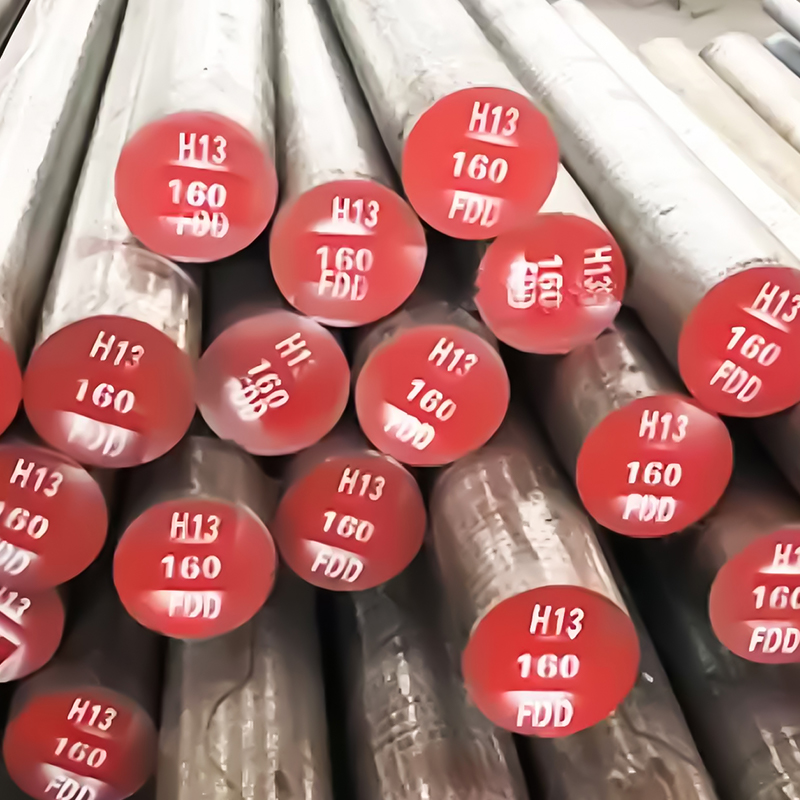
The principal limitation is tooling cost. Closed die sets in H13 hot work tool steel cost from tens of thousands to hundreds of thousands of dollars depending on part complexity, making the process economically viable only above a minimum production volume — generally 500–1,000 pieces or more depending on part size. Die life typically ranges from 10,000 to 100,000 strikes, influenced by forging temperature, material abrasiveness, and lubrication practice.
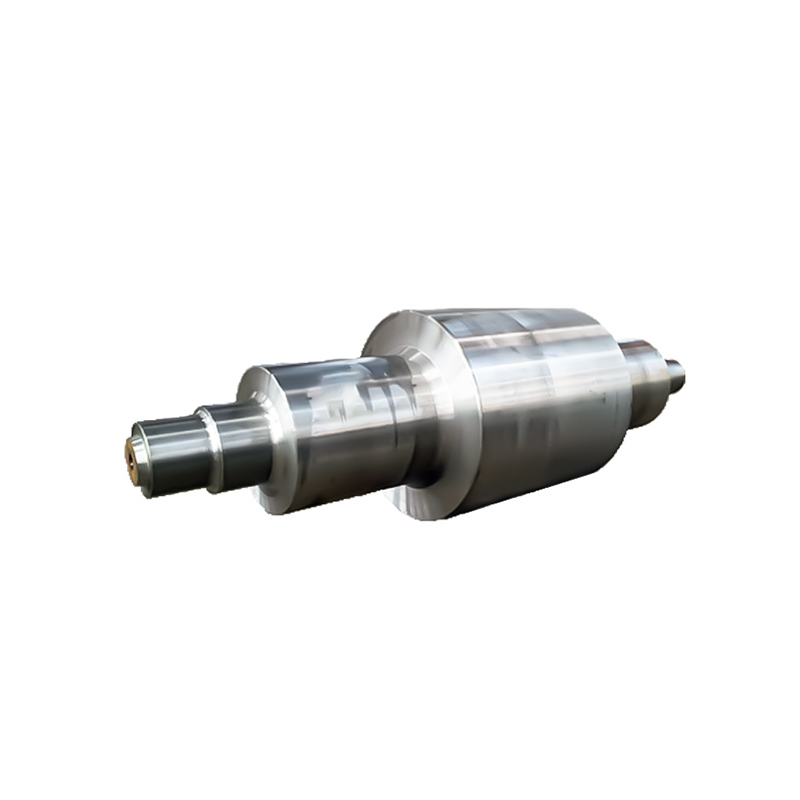
Open die forging shapes metal between flat or simply contoured dies that do not fully enclose the workpiece. The operator or automated manipulator repositions and rotates the hot billet incrementally between press strokes, gradually working the material to the desired shape through a series of deformation steps. Because no impression cavity confines the metal, part geometry depends on die movement, press stroke, and operator or CNC control — not on a pre-cut cavity.
Common open die tooling configurations include flat platens, V-dies, swaging dies, mandrel rings for hollow parts, and saddle dies for contoured profiles. The process accommodates an enormous range of part geometries including:
The most fundamental open die operation is cogging — also called drawing out — where the billet is progressively compressed along its length in overlapping bite increments to reduce cross-section and increase length. Each bite deforms a localized zone; the press operator advances the billet between strokes so that adjacent bites overlap by 30–50%, ensuring continuous deformation without cold shuts or laps at bite boundaries. Cogging is the primary method for working large ingots (1 ton to 300+ tons) down to intermediate billet sizes for further processing or final machining.
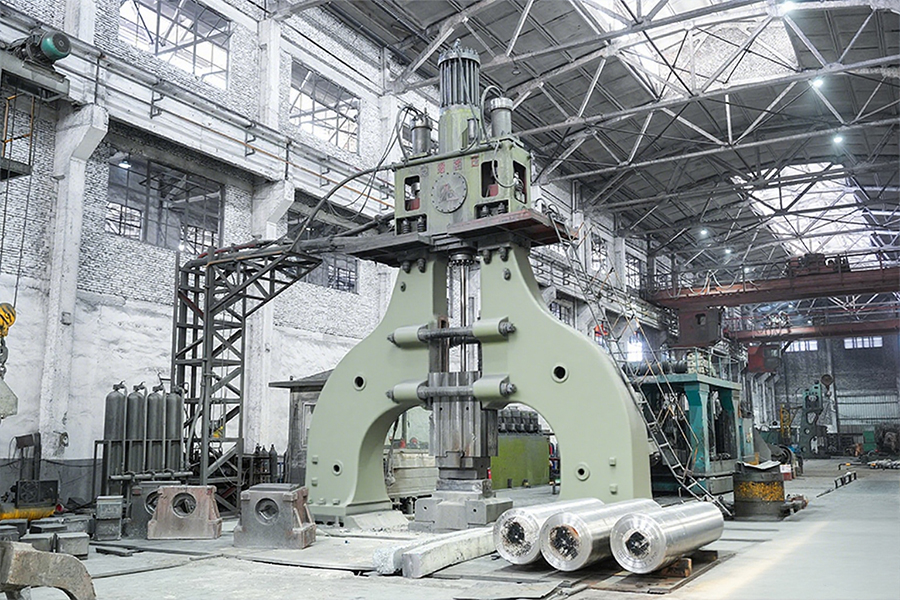
Open die forging operates on hydraulic presses ranging from 800 tons to over 125,000 tons for the largest aerospace and power generation forgings. The world's largest open die forging presses — 50,000 to 80,000 ton class — are capable of forging titanium and nickel superalloy components for aircraft fuselage frames and large turbine discs.
The two processes are complementary rather than competing. Open die forging is preferred when part size exceeds what closed die tooling can economically accommodate (typically above 200–500 kg), when production volumes are too low to justify die investment, or when the geometry is too complex or variable for a single-cavity die. Closed die forging is preferred when dimensional precision, surface finish, and production volume favor the tooling investment. Many large components begin as open die forged preforms that are subsequently closed die forged for critical features.
| Factor | Open Die Forging | Closed Die Forging |
|---|---|---|
| Typical part weight | 1 kg – 300+ tonnes | 0.1 kg – ~500 kg |
| Tooling cost | Low (flat dies) | High (machined cavity dies) |
| Dimensional tolerance | ±2–5 mm typical | ±0.3–1.5 mm typical |
| Minimum viable volume | 1 piece | 500–1,000+ pieces |
| Machining allowance | Large (3–15 mm per side) | Small (1–3 mm per side) |
| Shape complexity | Simple to moderate | Moderate to complex |
Forge welding is one of the oldest metalworking processes — it joins two pieces of metal by heating both to a plastic or semi-molten state and then applying sufficient compressive force to bond them at the atomic level, without any filler metal or flux other than what is used to clean the joint surfaces. The correct forge welding temperature for low-carbon and mild steel is typically 1,260–1,370 °C (2,300–2,500 °F) — the point at which the steel surface develops a characteristic bright yellow-white, almost sparking appearance and becomes sufficiently plastic for atomic diffusion bonding under hammer blows.
Forge welding temperature varies significantly with alloy composition, as it is governed by the solidus temperature of the metal and its plastic deformation behavior:
Scale and oxides on the metal surface prevent atomic contact and must be removed immediately before the weld strike. Borax (sodium tetraborate) is the most widely used forge welding flux — applied at around 900–1,000 °C as the steel approaches welding temperature, it melts and forms a liquid barrier that dissolves iron oxide scale and prevents re-oxidation during the final heating phase. Without flux, scale entrapped at the joint interface creates inclusions that weaken or prevent the weld. Some smiths use silica sand, iron filings, or proprietary flux formulations for specific alloy systems.
While hand forge welding survives in bladesmithing and artistic ironwork, industrial forge welding is most prominently applied in flash butt welding and induction pressure welding for pipe manufacturing and rail joining. Flash welding heats the faying surfaces by electrical resistance arcing (flashing), then applies an upset (axial compression) force to consolidate the joint — achieving forge welding conditions in a controlled, repeatable manner. This method is used to weld drill pipe, anchor chain, and rail sections where a fully forged, heat-affected-zone-free joint with base metal mechanical properties is required.
Carbon steel forgings are produced from steel whose primary strengthening mechanism is carbon content — ranging from low-carbon grades below 0.20% C through high-carbon grades above 0.60% C — without the significant alloy additions (chromium, nickel, molybdenum) that characterize alloy steel forgings. Carbon steel forgings represent the largest volume segment of the global forging industry, used in automotive drivetrain components, industrial machinery, construction equipment, oil and gas fittings, and hand tools.
Carbon content is the dominant variable governing the mechanical properties achievable in forged carbon steel:
The forging process imparts microstructural improvements that distinguish carbon steel forgings from castings or hot-rolled bar in the same grade. Hot working above the recrystallization temperature (approximately 720–750 °C for carbon steels) breaks down cast dendritic structure, closes solidification porosity and voids, and produces a refined, equiaxed grain structure. The mechanical working also develops a fibrous grain flow that — when aligned with the direction of principal stress in the finished part — significantly improves fatigue strength and impact toughness compared to bar stock machined across the grain.
Documented property improvements in AISI 1045 medium-carbon steel forgings versus equivalent castings include fatigue strength improvements of 20–37% and Charpy impact toughness improvements of 30–50% at room temperature, with even greater advantages at sub-zero temperatures relevant to oil and gas and Arctic applications.
As-forged carbon steel components are typically normalized (air-cooled from above Ac3) to relieve forging stresses and produce a uniform pearlitic-ferritic microstructure as a baseline for subsequent machining or heat treatment. Final mechanical properties are achieved by:
Carbon steel forgings are selected when the required mechanical properties fall within the achievable range of heat-treated carbon grades, and when hardenability requirements can be met in the cross-section being forged. For sections above approximately 50–75 mm, hardenability limitations become significant — the core of a large carbon steel forging may not reach full martensitic hardness during quenching, resulting in lower core toughness than the surface. Alloy steel grades (4140, 4340, 8620) are specified when deep hardenability, elevated-temperature strength, or corrosion resistance requirements exceed what carbon steel can provide. The trade-off is cost: carbon steel forgings in AISI 1045 run 15–35% lower in material cost than equivalent alloy steel forgings.

No.1317 Gangcheng Road, Daxin Town, Zhangjiagang, Jiangsu, China
WhatsApp:+86-151 5156 6388 Terry Huang
+86-151 5156 6388 Terry Huang
+86-138 1299 2607 Maggie Xia
Terry Huang -VP of Sales
[email protected]
Maggie Xia -VP of Sales
[email protected]

 Previous