
 English
 Español
 русский
News
Home / News / Company News / Maiterio Takes on 1Cr13, 2Cr13 & 4Cr13 Martensitic Stainless Steel Ring Forgings
This year, Maiterio reached a new milestone in ring forging materials by producing 1Cr13, 2Cr13, and 4Cr13 martensitic stainless steel ring forgings for the first time.
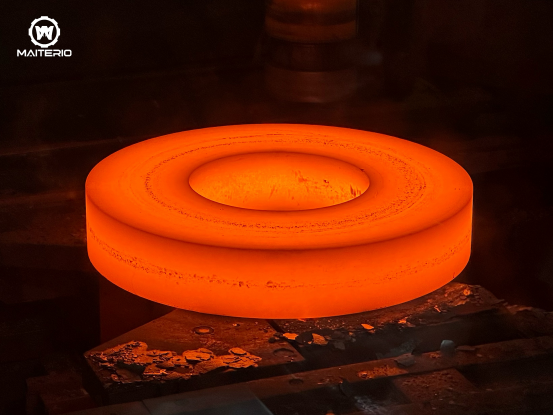
We have extensive experience in producing ring forgings from carbon steel, alloy steel, and other materials. However, these three stainless steel grades were new to us. From the initial heating and forging stages to final forming, we needed to understand their material characteristics and adjust the forging process accordingly.
One of the biggest challenges with these martensitic stainless steels is their high forging difficulty and increased risk of cracking.
During forging, 1Cr13, 2Cr13, and 4Cr13 are sensitive to heating temperature, soaking time, deformation amount, forging sequence, and cooling conditions.
Improper temperature control or excessive deformation in a single pass can increase the risk of cracking. For ring forgings, the billet also undergoes continuous reduction, radial expansion, and changes in wall thickness, placing higher demands on process control throughout the entire forging operation.
This means that standard forging parameters cannot simply be applied. The process needs to be adjusted according to the actual condition of the material during production.
Without previous production experience with these materials, we began developing our process step by step with the first batch.
From initial heating to the reduction amount, deformation sequence, and coordination between forging passes, adjustments were made according to the actual condition of each billet.
Our focus was not simply on whether the material could be forged, but on how to achieve sufficient deformation while reducing the risk of cracking and maintaining stable forming throughout the process.
Through continuous production, observation, and process adjustment, we gradually accumulated practical production experience in 1Cr13, 2Cr13, and 4Cr13 martensitic stainless steel ring forgings.
This production was more than simply completing a new batch of ring forgings. It also represents an expansion of Maiterio’s capabilities in material applications.
From having no prior experience in these materials to achieving formal production and stable batch production, Maiterio has accumulated practical production experience in a new range of forging materials.

No.1317 Gangcheng Road, Daxin Town, Zhangjiagang, Jiangsu, China
WhatsApp:+86-151 5156 6388 Terry Huang
+86-151 5156 6388 Terry Huang
+86-138 1299 2607 Maggie Xia
Terry Huang -VP of Sales
[email protected]
Maggie Xia -VP of Sales
[email protected]

 Previous